


The real AI revolution is not using a tool. It is building an internal capability.
A strategic and operational programme for established companies that want to organise their AI adoption, train internal people and build AI agents, applications, software, automation and local architectures without reducing artificial intelligence to a collection of isolated experiments.
Designed for organisations that are not looking for a generic AI course, but for progressive transformation across governance, people, processes, data, tools and autonomy.
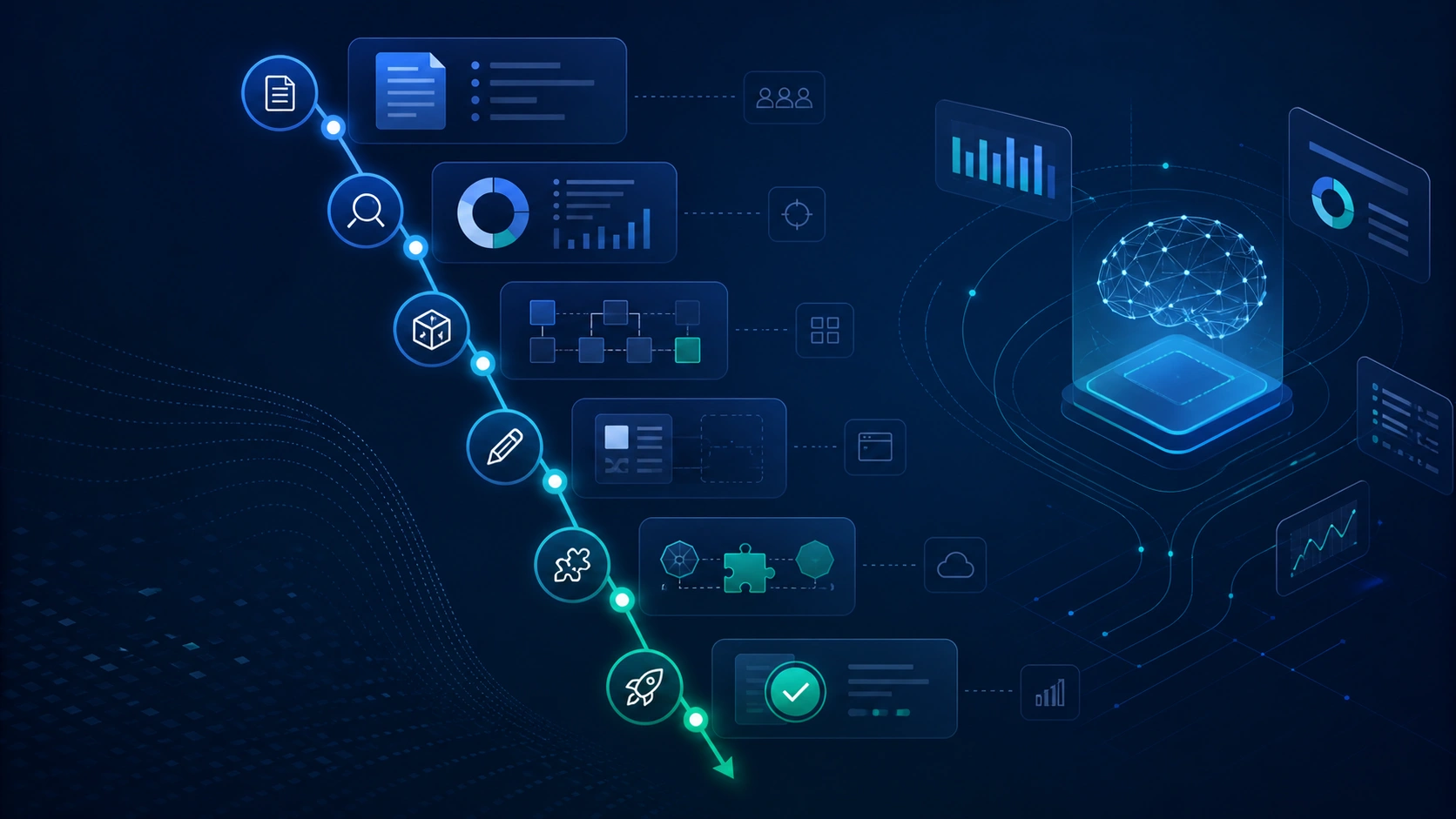
Operational agents
AI workflows integrated into real processes.
Trained team
Internal people able to use and govern AI.
On-premise
Data and models remain under control when required.
IIoT and edge
Local AI close to plants, sensors and machines.
Many companies are buying AI tools. Few are building an AI capability.
Agents that can write code, read files, operate digital environments and complete multi-step tasks change the nature of the problem. It is no longer enough to ask which subscription to buy. Companies must decide how AI enters processes, who controls it, which data it may use, which outputs it produces and how internal people become capable of evolving it.
Disorganised experimentation
Isolated chatbots, prompts and tools create initial enthusiasm, but often fail to change how the company actually works.
Data and privacy
Documents, contracts, industrial information, customer data and internal procedures cannot be processed without a technical and organisational framework.
No roadmap
Without priorities, KPIs, responsibilities and an adoption plan, AI remains a side initiative rather than a structural capability.
External dependency
If everything remains outside the company, every new agent, application or automation continues to depend on external suppliers, schedules and costs.
The best investment is not replacing people. It is training them to build with AI.
An established mid-sized company already has the raw material: processes, experience, data and people who understand customers, production, administration, sales, marketing and operations. AI becomes powerful when this knowledge is converted into an operating method.
Consulting provides that structure: identifying where to intervene, designing secure architectures, training internal people, building the first agents and leaving the company with a progressively stronger ability to develop autonomously.
First, create order
Processes, data, software, risks, permissions and priorities are mapped before any agent is built.
Then, build
Agentic workflows, RAG systems, dashboards, automation, internal applications, websites, software and vertical tools are developed around concrete use cases.
The capability remains
The result is not only a delivered project, but an internal team that is better able to use, control and evolve AI.
A continuous programme that makes AI part of the company structure.
The programme may last six months or a year, with intensity adjusted to the size of the company. The logic is straightforward: initial assessment, roadmap, development of the first agents, staff training, governance and progressive transfer of capabilities.
AI Readiness & Governance Check
Analysis of processes, departments, data, software, policies, risks, use cases and digital maturity. Output: a clear current-state assessment and initial priorities.
AI growth plan
Definition of use cases, KPIs, technical architecture, cloud/on-premise choices, budget, project phases and internal responsibilities.
First agents and applications
Development of AI agents, RAG, automation, dashboards, internal applications or specific software starting from the highest-impact processes.
Staff training
Practical training on prompts, agents, documentation, testing, output control, data handling, assisted-development tools and agentic workflows.
Rules, logs and supervision
Internal procedures, permissions, human oversight, traceability, use-case documentation and criteria for deciding what should be automated.
Progressive capability transfer
The company becomes able to manage new ideas, small agents, prototypes, automation and internal requests autonomously, with support that can be reduced over time.
Agents, applications and software built around real work.
The objective is not to “do AI” in the abstract. It is to use AI to reduce friction, idle time, manual hand-offs, repetitive errors and information loss.
Administration and documents
Reading invoices, contracts, procedures, reports, email and PDF archives; classification, data extraction and reconciliation.
Sales and CRM
Lead analysis, quotation preparation, follow-up, conversation summaries, customer profiling and sales-team support.
Marketing and content
SEO, editorial plans, landing pages, competitor analysis, campaigns, reports and controlled production of company content.
Software and websites
Internal applications, Streamlit tools, Python scripts, mini-CMS systems, automation, dashboards and development assisted by coding agents.
Business intelligence
Automated reports, KPIs, queries over company data, management summaries and RAG systems over documents and knowledge bases.
Operations and IIoT
Operational diagnostics, log reading, anomaly detection, edge gateways, compact models and local agents close to machines and plants.
AI in business must be useful, but also governable.
The European AI regulation should not be read merely as an obstacle, but as a clear signal: artificial intelligence must be introduced with defined roles, responsibilities, documentation, human oversight, data control and internal competence.
For this reason, the programme starts with governance rather than tools. The company must know which systems are used, which data they process, where processing takes place, who validates outputs, what is logged and which activities must remain under human control.
When data are sensitive or strategic, the architecture can be local, on-premise or hybrid: cloud where it is advantageous, local where control is required.
What is brought under control
AI-use inventory
Where AI is already used, by whom, with which tools and on which data.
Data classification
Confidential documents, personal data, industrial data, commercial information and internal archives.
Human oversight
Clear rules defining what an agent may do and what must be validated by a person.
Documentation and logs
Traceability of decisions, versions, prompts, procedures, tests and operational limits.
The same logic can extend into plants, sensors and industrial systems.
IIoT does not require a large language model on every sensor. It requires a distributed architecture in which every layer does its own job: detect, aggregate, interpret, explain and suggest actions.
Intelligence becomes more useful when it is close to the machine, inside the plant, under company control and not entirely dependent on external cloud services.
Sensors and TinyML
Recognition of simple patterns: abnormal vibrations, out-of-curve temperatures, irregular consumption and unusual sounds.
Edge gateway
Raspberry Pi systems, industrial mini-PCs or local edge servers aggregate data, logs and signals and convert them into readable information.
Compact models
Lightweight local models can classify anomalies, read logs, produce structured output and summarise operational guidance.
Local agent
Python, databases, MQTT, Modbus, internal APIs and company rules connect signals and generate operational diagnoses.
Correct chain: sensors → TinyML → edge gateway → compact model → local agent → operational diagnosis.
A programme for companies that want to become stronger, not merely more automated.
It works when company leadership is prepared to create order, select priorities and involve internal people. It is not intended for organisations seeking only a quick demonstration or a motivational course.
Advanced SMEs
Companies with existing departments, processes, documents, data and software that are not yet coordinated around AI.
Industrial companies
Environments involving operations, logs, maintenance, plants, sensors, quality, production or a need for local and edge AI.
Leadership and IT teams
Entrepreneurs, CEOs, digital leaders, IT managers and operations managers who need a concrete roadmap.
After 6–12 months, the company should not merely have “used AI”. It should know how to govern it.
The outcome is a more mature structure: a roadmap, real agents or applications, trained staff, documented procedures, better-informed infrastructure choices and a clear direction for continuing.
This is the decisive transition: from AI as an external tool to AI as an internal capability.
Clear roadmap
What to do, in which order, with which priorities and investment.
Real agents
Solutions developed around company processes, not disconnected prototypes.
Autonomous people
Internal people able to use, control and improve the tools.
Do you want to understand whether your company can become autonomous in its use of AI?
Complete the form. The first step is to understand your sector, company size, current software, critical areas, data sensitivity and the required level of support. From there, we can determine whether to begin with an assessment and which programme is appropriate.