


AI agents: not simple chatbots, but systems that help the company work better.
An AI agent can read data, consult documents, use tools, follow a procedure, prepare outputs and request approval when needed. The difference is not only technical: it is organizational.
An AI agent works toward objectives, not only answers.
A classic chatbot receives a question and returns an answer. An AI agent, instead, can break a task into steps, retrieve data from internal sources, use external tools, produce a draft, check it and deliver it in the required format.
The key is not giving it “more intelligence”, but building an operational perimeter around it: what it can do, which sources it can use, when it must stop, when it must ask for confirmation and how it must be controlled.
Chatbot
It answers questions. It is useful, but often remains inside a conversation and does not execute a real process.
AI Agent
It follows an objective, reads sources, uses tools, prepares outputs and can work inside a controlled flow.
Automation
It executes fixed rules. It is stable, but less suitable when inputs and documents change frequently.
Multi-agent system
Several specialized agents collaborate: one analyzes, one generates, one verifies, and one prepares delivery.
A useful agent is created by combining an AI model, data, tools and rules.
The language model is only one part. To become operational, the agent must know where to search, which tools to use, which steps to follow and which limits not to cross.
AI model
ChatGPT, Gemini, Claude or a local model. The choice depends on quality, privacy, speed and costs.
Memory and sources
Documents, knowledge bases, CRM, sheets, databases, manuals, procedures and company history.
Tools and APIs
Email, Drive, Sheets, CRM, management systems, controlled browsers, internal APIs or document systems.
Rules and control
Permissions, logs, cited sources, approvals, autonomy limits and exception handling.
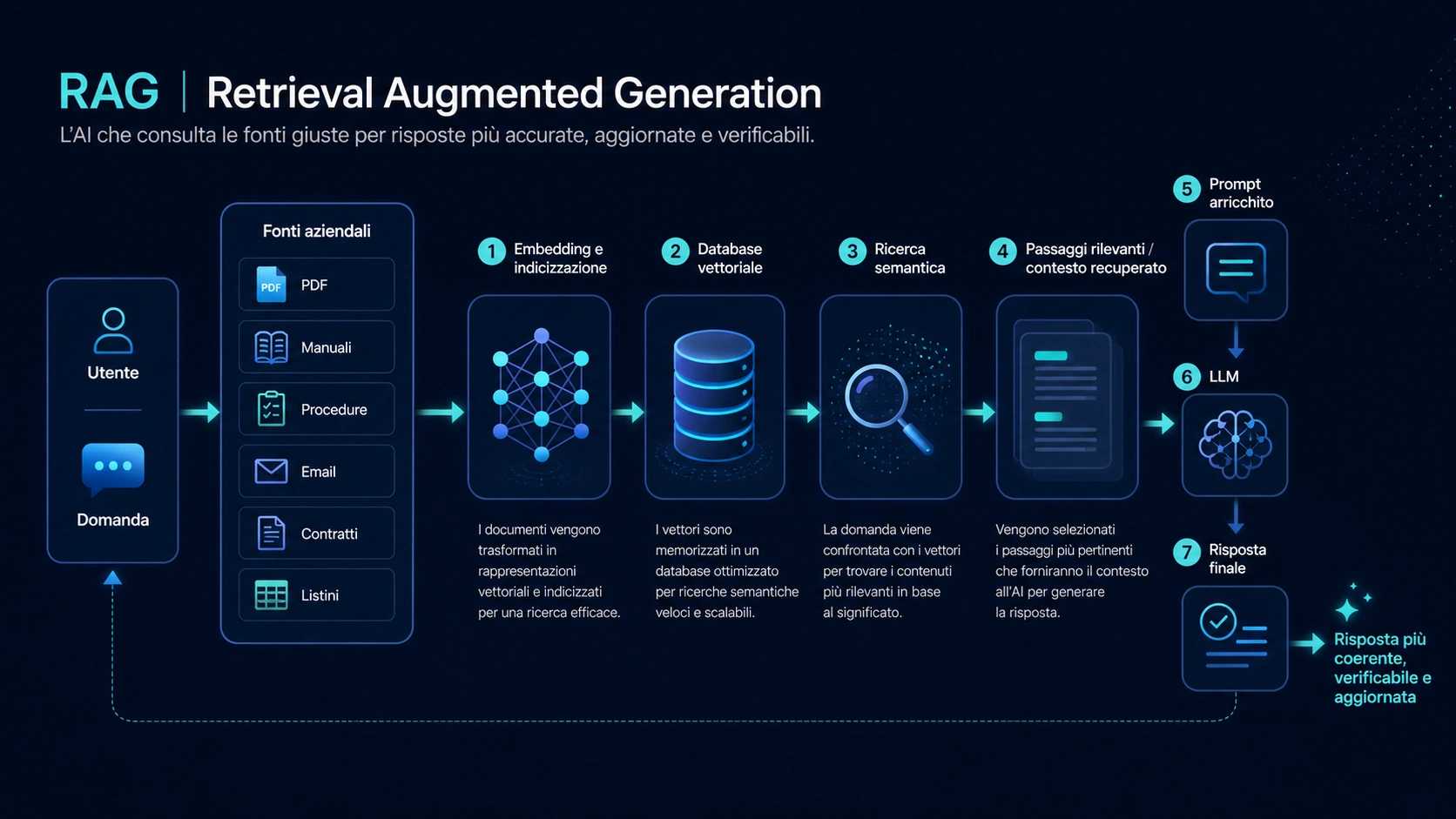
To work well, the agent must be able to consult the right sources.
Many companies already have the answers in their documents, but they are hard to find: manuals, contracts, price lists, procedures, presentations, email, technical sheets and spreadsheets. A RAG system allows the agent to query these materials and build answers that are closer to the real context.
RAG does not automatically make a system perfect, but it improves control because it ties the answer to retrievable, verifiable and updatable sources.
Examples of AI agents that an SME can actually use.
An AI agent does not have to start as a huge project. It can be built for a department, a process, a type of document or a precise operational routine.
Operational marketing agent
Raccoglie fonti, prepara insight, propone contenuti, organizza piani editoriali e supporta report periodici.
Google Workspace agent
It consults Drive, prepares summaries, organizes data in Sheets and supports email and document flows.
Sensitive-data agent
It can be designed in a controlled cloud, locally or on premise when privacy and data governance are central.

Every company works differently. The agent must adapt to the method, not disrupt it.
Examples and case studies help clarify what is possible, but in reality every sector has different rules, software, habits and priorities. Industry, commerce, professional firms, finance, legal, design, advertising and services do not have the same flows or tools.
That is why the proposal does not start from a predefined package. It starts from an introductory call, from analyzing how you work today and from checking the tools already in place: management systems, CRM, creative suites, spreadsheets, document archives, email, vertical software, cloud platforms or internal systems.
Introductory call
First we clarify the context: department, objective, urgency, constraints, users involved and practical problems to reduce.
Flow mapping
We observe steps, responsibilities, documents, exceptions and the points where AI can help without creating friction.
Software and integrations
The agent can be designed around the company's real tools, not only Office: CRM, ERP, databases, Drive, email, industry software, APIs or local archives.
Adaptation to your method
The goal is to build agents that respect the way you decide, approve, produce, communicate and control work.
The point is operational compatibility.
A useful AI agent should not force the company to work “the way the software wants”. It should fit into existing flows and improve them where it makes sense.
Professionals
Accountants, consultants, legal or financial firms with documents, deadlines, opinions and case files.
Operational companies
Industry, distribution, logistics or commerce with processes, orders, inventory and technical requests.
Creativity and marketing
Agencies, design, advertising and content teams with workflows, revisions, assets, campaigns and client reports.
An AI agent must be useful, but also controllable.
Risk is not managed by promising that AI will “never make mistakes”. It is managed by designing the perimeter well: sources, permissions, approvals, tracking, autonomy thresholds and human intervention.
That is why every serious agent should have a control system proportionate to the task it performs.
Human in the loop
For sensitive activities, the agent prepares drafts and suggestions. The final decision remains with a person.
Sources and traceability
Answers can cite the documents, sections or datasets used, so the team can verify the operational reasoning.
Permissions and limits
Not every agent should be able to send email, modify files or update CRM records. Each action must be authorized by role and context.
The most common questions about AI agents.
Does an AI agent replace a chatbot?
No. A chatbot answers. An agent can follow a flow, consult sources, use tools and produce an operational result.
Can it work on our documents?
Yes, if it is designed with RAG, correct permissions and organized company sources. It is better to start from clean and updated documents.
Cloud or local?
It depends on budget, privacy, volumes and required quality. Often the best solution is hybrid: cloud for complex tasks, local for sensitive data or routines.
Do you want to understand whether an AI agent makes sense for your process?
Tell me what it should do, which tools you use, which documents need to be consulted and what result you want to obtain. From there we can understand whether you need an agent, RAG, automation or a simpler solution.