
Local and on-premise AI
Inference can run on infrastructure agreed with the business. Models, capacity and performance depend on the configuration: the project starts with the actual workload.
Ergoware’s flagship product
Knowledge, local models and tools in one workspace. An on-premise AI architecture designed to preserve know-how and support the way people work.
The problem we start from
Procedures, documents, experience and decisions are often spread across folders, applications and individual employees. When someone changes roles, part of that context can be lost. Brain Company is being developed to turn this knowledge into a resource that people can search and reuse.
The project connects what the business knows with the tools it uses. People make a request; the platform finds relevant context, coordinates its components and supports the work through a controlled workflow.
Inside the platform
Inference can run on infrastructure agreed with the business. Models, capacity and performance depend on the configuration: the project starts with the actual workload.
Documents and internal information become sources to search and consult. Generation is connected to the available context, keeping source material distinct from the model’s responses.
OpenClaw acts as the orchestrator, working with Brain Core and the platform’s modules: requests, context, planning and tools form part of the same operational workflow.
The architecture supports reusing tools, building new capabilities when needed, sandbox testing and validation. Actions need to be bounded by explicit permissions and responsibilities.
Validated procedures, results and useful feedback can inform an operational memory. Remembering information and updating a model are separate processes that need to be governed independently.
Approved applications and services can be integrated through connectors. External connections depend on the business’s permissions, network and deployment choices.
The laptop workspace
The first laptop version makes it possible to try the approach in a working environment, bringing conversation, business knowledge and operational functions into the same interface.
The screenshot shows a development version. The interface, modules and availability of features evolve between releases; the trial is intended to assess usefulness, sources and workflows in the business’s own context.
Let’s discuss a trial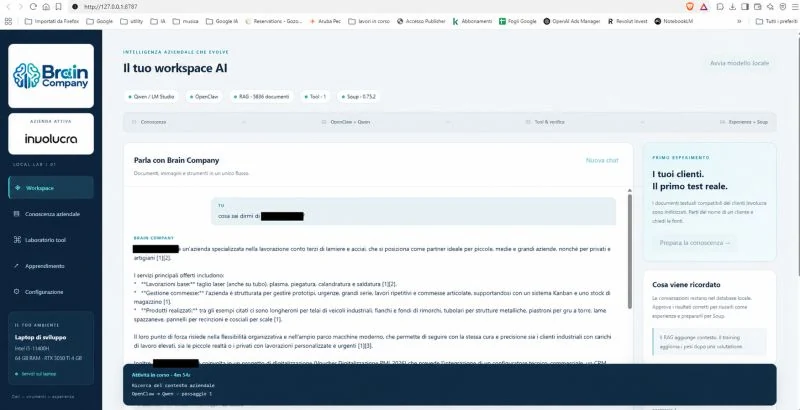
Architecture and operation
The diagram connects four layers: orchestration and knowledge, operational workflows and tools, controlled evolution, and infrastructure. It maps the project rather than promising that every module is available in every version.
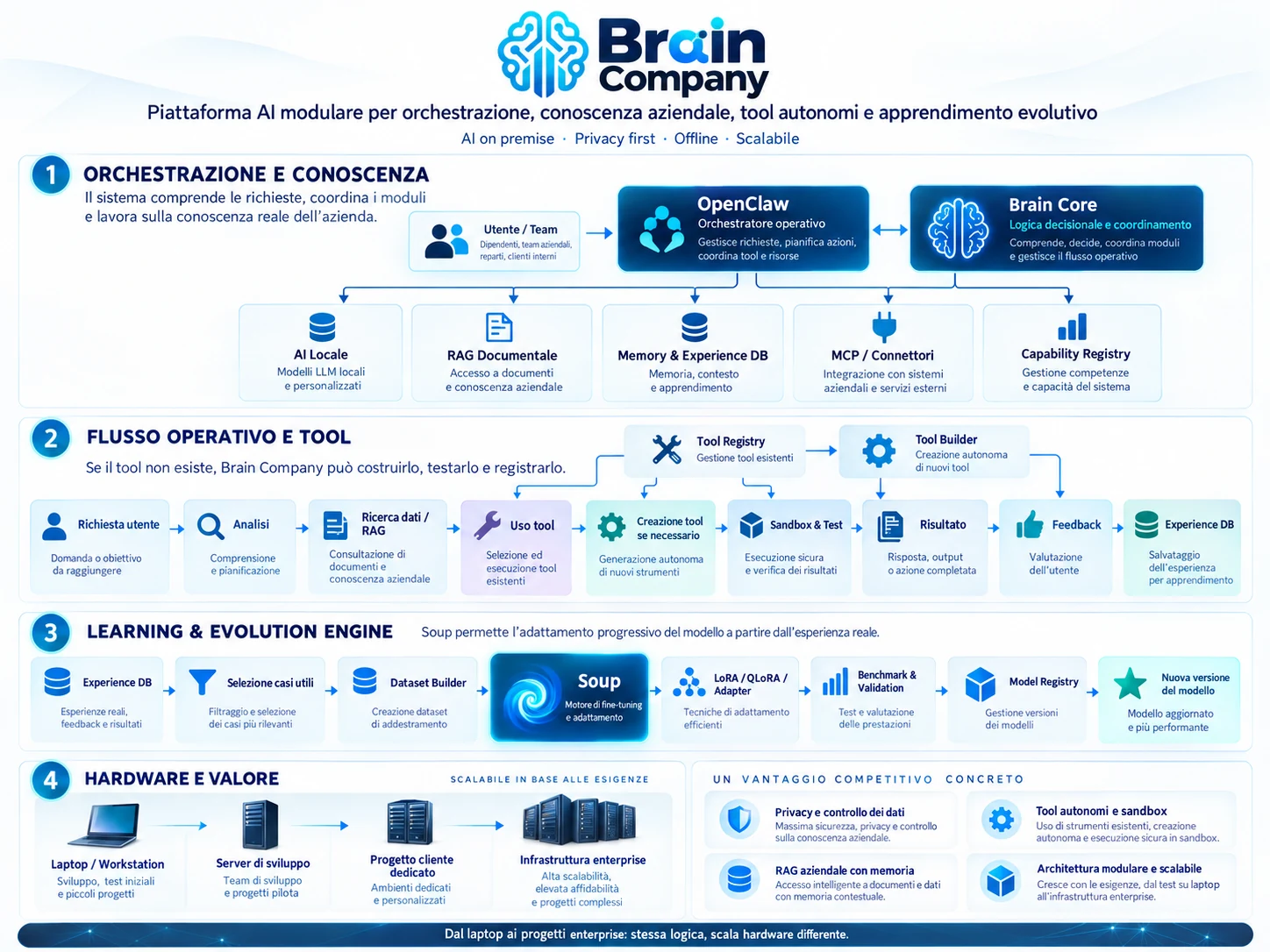
Architecture diagram supplied by Ergoware. Open the image to read the details.
Read the request and retrieve context from authorised documents and memory.
Select models, tools and steps appropriate to the task.
Test new capabilities, check outputs and maintain the required supervision.
Retain useful experience and evaluate adaptations before versioning a new model.
A structured approach to evolution
Memory makes context reusable. The model adaptation process, labelled Soup in the diagram, instead involves selecting useful cases, building a dataset, techniques such as LoRA or QLoRA, benchmarks and version management.
Project status · November 2026
An initial version has already been produced to begin trials. Availability of a demo or test is agreed directly with Ergoware.
A new release is being prepared with several additions. Details and availability will be announced on release, without pre-announcing unpublished features.
The first release for NVIDIA DGX Spark infrastructure is ready for release. Configuration and adoption arrangements will be defined for each project.
Brain Company is in research and development. These details describe the status communicated by Ergoware in November 2026; they are not an offer of a public download or hardware certification.
The official presentation
Private AI, business knowledge and automation: Ergoware’s presentation of the project’s vision.
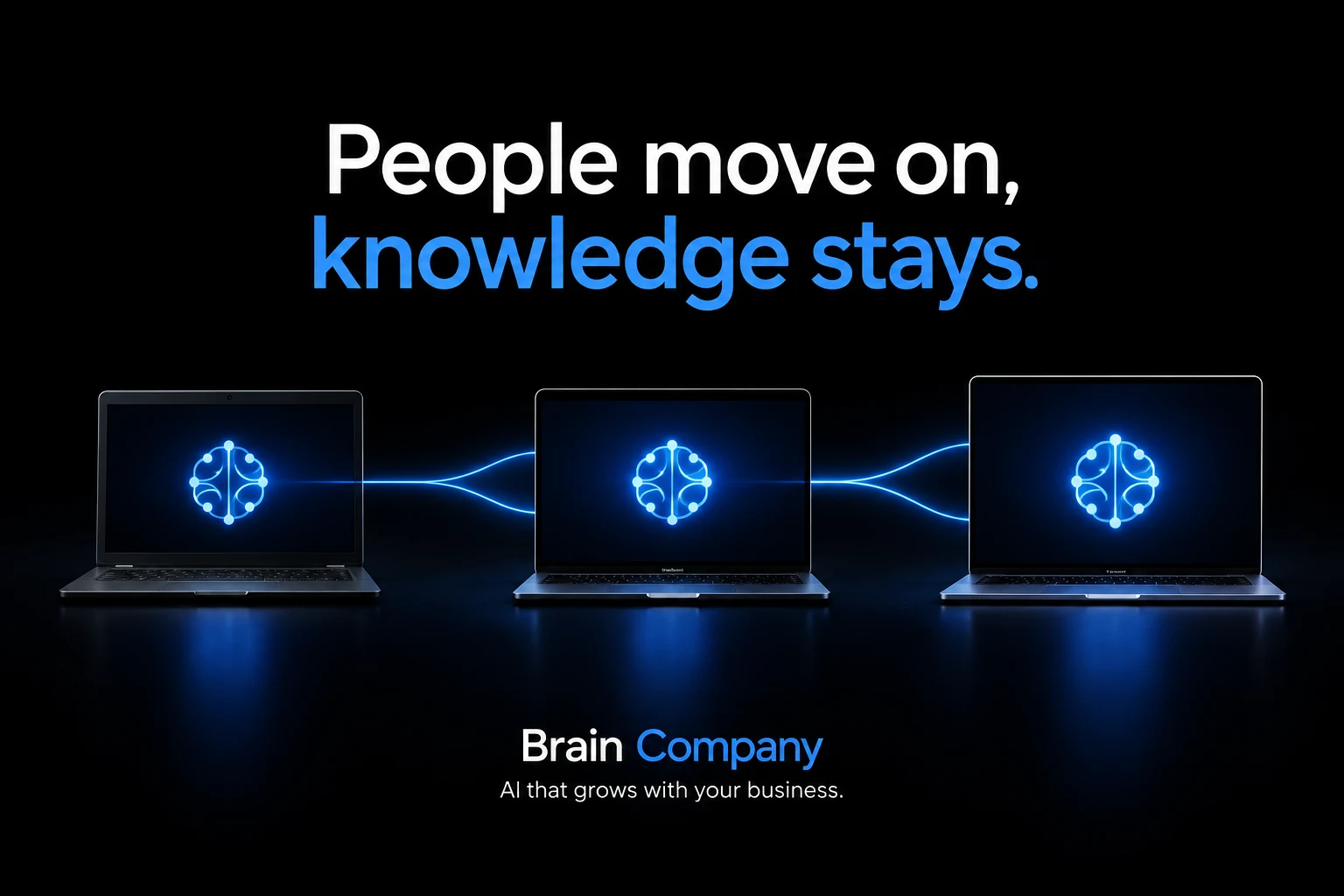
The principle behind the project
Documenting what works and making it accessible can support business continuity. The platform assists people at work, makes use of context and keeps the organisation at the centre of decisions.
Read more on the blogPromotional video created using AI generation tools.
We start with the processes, documents and infrastructure you already have. Together, we define an initial use case to test.
This website uses necessary technical cookies and may save your cookie preference in the browser. Any statistical measurement tools will be activated only with your consent. We do not use marketing or advertising profiling cookies on this version of the website.