
In summary
People move on, knowledge stays. Procedures, customer responses and everyday decisions build a business’s knowledge, but that knowledge often remains divided between documents, software and people. Brain Company is being developed to connect these sources, give models context and coordinate working tools. This article explores the project’s vision, the role of RAG and memory, the presentation video and the status of versions in research and development.
A business knows far more than it can easily retrieve.
Every day, a business produces knowledge: an updated procedure, a customer response, the reasoning behind a choice or a check that prevents an error. Some of it ends up in documents, some in software and some remains in people’s experience. The problem becomes apparent when all of this needs to be connected to get a job done.
A folder does not remember why a step matters. A generic chatbot does not automatically know your organisation’s context. And an isolated automation can speed up one task while leaving the problems between departments untouched.
Brain Company is being developed to bridge this gap between available information and the ability to use it. It is Ergoware Ltd’s flagship product, currently in research and development, designed to bring local models, knowledge, tools and operational memory together in an extensible architecture.
People move on, knowledge stays.
The motto expresses an objective: making know-how more accessible and less vulnerable to change. It does not mean replacing people. It means building a system that helps them find context, use tools and retain what has proved useful.
What Brain Company is
Brain Company is an on-premise AI platform designed to work on infrastructure controlled by the business. It goes beyond a conversational interface, connecting models, document sources, memory, connectors and workflows.
Choosing a local approach has a practical meaning: deciding where models run and how they connect to data. Performance, model capabilities and costs depend on the configuration; the starting point remains the task the organisation wants to perform.
A solution can be trialled on a laptop and then evaluated on a workstation or dedicated infrastructure. The Brain Company page describes the architecture and version status without presenting the roadmap as a catalogue of features already available.
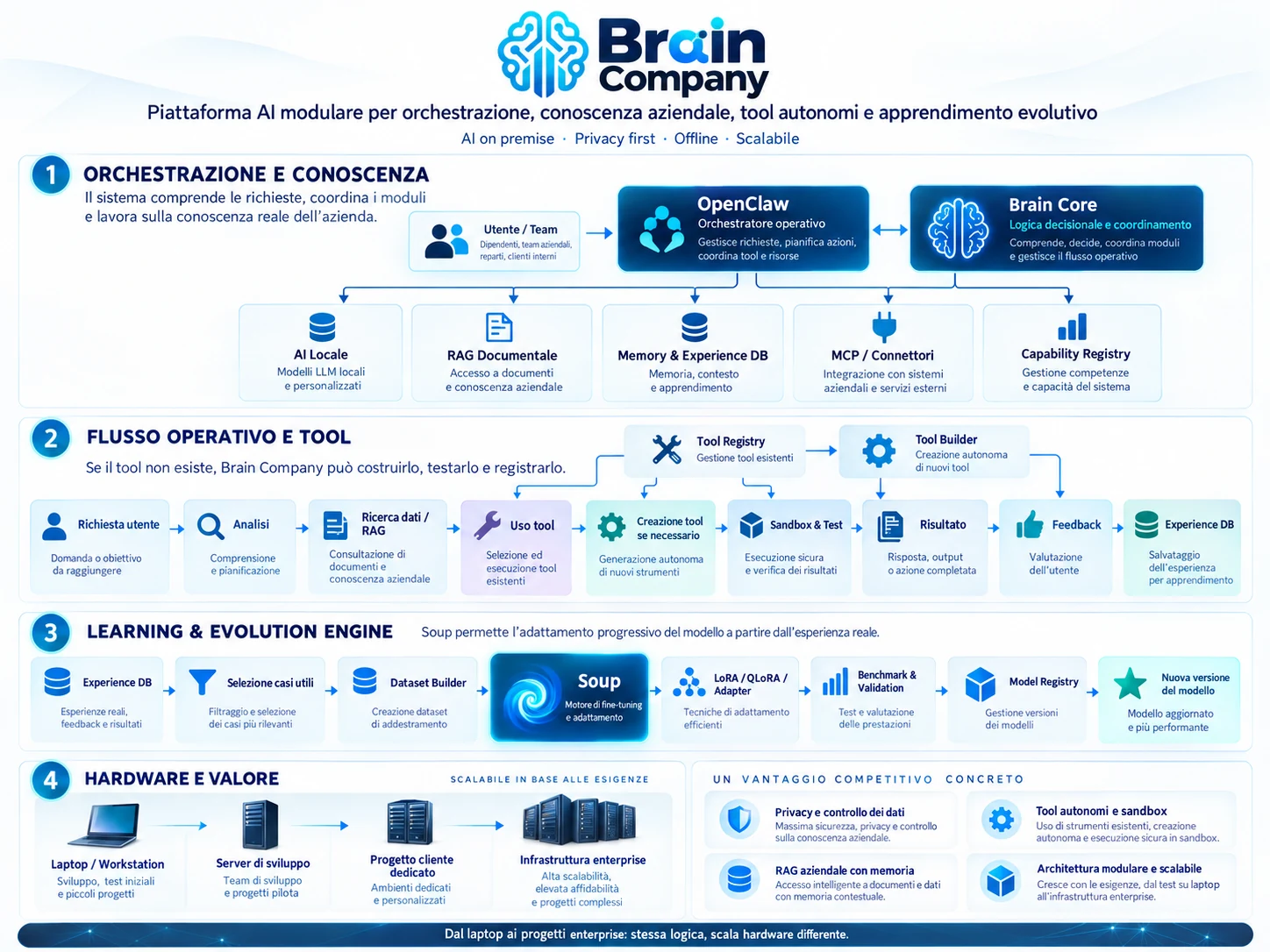
An architecture connecting request, context and action
The architecture diagram distinguishes several layers. The user brings a question or objective; OpenClaw and Brain Core coordinate the components needed. The system can retrieve context from documents, call registered capabilities and organise the steps of the work.
RAG: consulting business knowledge
Document retrieval connects the model to sources. Before asking for an answer, it is necessary to understand which documents are available, up to date and authorised for the user. Knowledge quality also depends on organisation, versions and permissions, not just model size.
A useful question for an initial trial might be: ‘Which procedure describes this step?’ The test would aim to verify whether the system finds the right document and whether the response allows the person to check it. This is an example of validation rather than a report of a result already measured.
Tools and connectors: moving from answers to work
MCP connectors and the tool registry make it possible to design connections with approved applications and services. Within the architecture, a tool can be reused or built, sandbox-tested and registered when needed.
Autonomy needs boundaries: which actions are permitted, which require confirmation, which credentials are used and how an error is handled. Having an agent does not eliminate these choices; it makes them part of the project.
Memory and evolution: two distinct layers
Retaining information and modifying a model are not the same operation. Operational memory can make validated context and experiences reusable. Adaptation, by contrast, requires selecting cases, preparing data, testing and version management.
In the diagram, the Soup process connects experience, datasets, techniques such as LoRA or QLoRA, and benchmarks. The direction is controlled evolution: changes need to be evaluated before they affect real use. We are not describing a model that automatically retrains itself after every conversation.
Brain Company in the official presentation
The video brings together the project’s vision: private AI, business knowledge and automation under the organisation’s control.
Where we are in November 2026
A first laptop version for testing has already been produced. The third laptop release is planned by the end of November 2026, with additions to be detailed on release. The first release for NVIDIA DGX Spark is ready for release.
These details describe the research and development status communicated by Ergoware. Test availability is agreed directly; there is no public software download and no claims are made about unmeasured performance.
Brain Company will be presented at TECHXPO Malta 2026, from 26 to 28 November. For us, it will be an opportunity to exchange ideas with those who want to move from separate experiments towards an internal operational capability.
Local does not mean free of responsibilities
Running inference on business infrastructure can increase technical control. The data used, external connections, access and the types of decision supported by AI still need to be assessed. A local platform alone is not certification of compliance.
That is why we connect the project to an approach to business AI governance, training and human oversight. The EU AI Act guide helps explain roles and obligations; the specific case then needs to be analysed.
Where to start in your business
The first step is not to connect everything. It is to choose a process whose value can be verified: a set of documents, a procedure, a repetitive activity or a hand-off between tools. Inputs, the expected result and responsibility for review need to be defined.
- Describe the work as it is today. Where do people look for context? Which errors or delays keep recurring?
- Identify sources and boundaries. Which data and tools can be used in the trial?
- Define what success looks like. Quality, traceability, time and the review workload need to be compared with the current process.
- Validate before extending. A useful trial helps establish what to consolidate and what to change.
If you have not yet identified a starting point, MappAI Valore offers an initial view of AI opportunities. If you already have a specific use case, we can discuss the possibility of a Brain Company trial.
Our direction is simple: to help tools and knowledge work together while leaving the organisation in control of the choices that matter.
Would you like to apply AI to your company?
Let’s evaluate Brain Company on a concrete use case in your business.
We start with the documents, processes and tools you already use to define a trial and shared assessment criteria.