
In summary
Many companies want to use artificial intelligence, but start with tools rather than operational realities. This is precisely where an AI Architect in Residence helps: analysing processes, data, software and constraints, defining a roadmap and providing ongoing guidance for the implementation of AI agents, RAG, automation and training in a sustainable, manageable way.
Why so many companies stop at tools
The problem is not a lack of tools. It is a lack of direction. In many companies, AI arrives as a collection of scattered initiatives: a few prompts, a cloud subscription, a demo, a small test. Initial enthusiasm is strong, but questions then emerge about data, costs, processes, responsibilities and integrations.
Without a clear map, AI risks remaining a collection of isolated attempts. Effort is spent without building internal capability. This is exactly where a coordinating role is needed.
What an AI Architect in Residence is
An AI Architect in Residence provides ongoing support, rather than a one-off consultation or staff augmentation. This person works within the organisation for an agreed number of hours to analyse real work, set priorities and guide the development of the company's AI infrastructure.
The role connects strategy, processes and technology. It starts with practical needs rather than tools: where time is lost, which departments experience the most friction, which data really matters, which workflows can be automated and which privacy or governance requirements must be met.
What the role does in practice
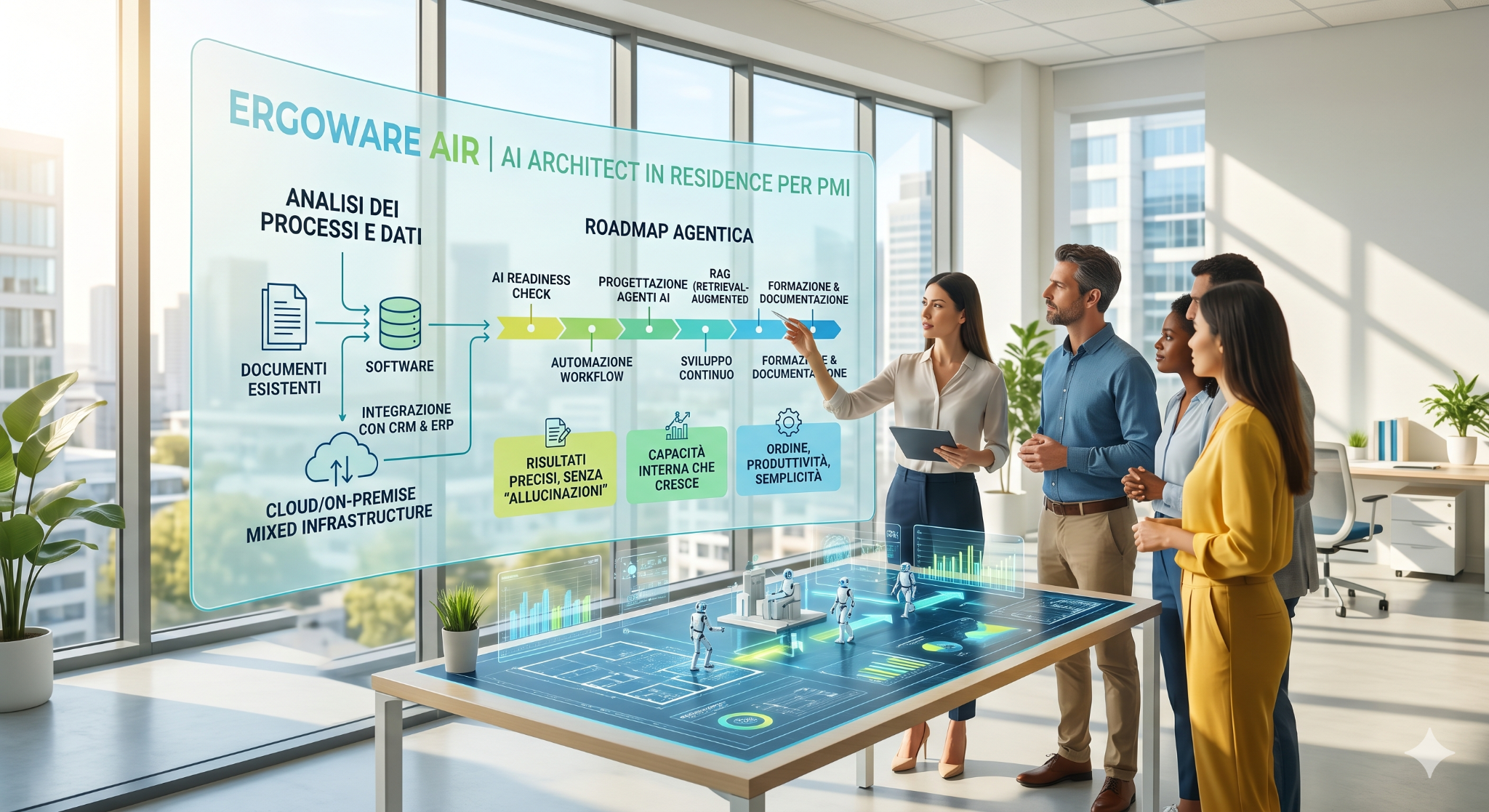
- AI Readiness Check: an initial analysis of processes, software, data, people, constraints and opportunities.
- Agentic roadmap: identifying priorities and the use cases with the greatest impact.
- Design and development: AI agents, RAG systems, automation, dashboards and integrations with CRM, ERP, databases or cloud tools.
- Governance and sustainability: managing costs, policies, roles, access, logs and oversight.
- Training: developing the team's internal capabilities to avoid complete dependence on external support.
In this way, the company does more than buy a solution. It builds a method and a capability that grow over time.
How the work progresses month by month
The soundest model is ongoing monthly support. Depending on the company's size and the complexity of its processes, plans can provide 8, 16, 24 or 40 hours per month, always with clear objectives.
One month may focus on analysis and priorities, the next on the first AI agent or a RAG system, and the following month on dashboards, integrations or training. This approach makes budgets more predictable and prevents AI from becoming a single, expensive project that is difficult to manage.
What can actually be built
With ongoing technical direction, companies can develop tools that are genuinely useful in daily work:
- specialist AI agents for operational and document support;
- RAG systems for querying procedures, manuals and internal knowledge bases;
- automation for email, reports, workflows and alerts;
- dashboards for monitoring and management analysis;
- integrations with business software, APIs, databases, spreadsheets and archives.
The aim is not to pursue every possibility, but to build an ecosystem that truly improves organisation, productivity and simplicity.
Why it differs from general consulting
General consulting often stops at explaining what could be done. An AI Architect in Residence supports the company throughout the transition: measuring, designing, developing, training and adapting the plan in response to results.
The role goes beyond introducing software. It helps the organisation govern AI while steadily developing internal expertise, clearer processes and better decision-making.
When it makes sense for an SME
It makes sense when a company believes AI could provide an advantage but wants to avoid a disorganised approach. It is particularly useful when several departments are involved, multiple software systems are in use, many documents or data sources need connecting, and there is a need to avoid waste, lock-in or unplanned implementations.
In these circumstances, technical direction makes the difference between passing enthusiasm and real internal capability that develops month after month.
Would you like to understand how to apply this in your company or practice?
Would you like to find out whether your company needs ongoing AI direction?
We can start by analysing processes, software and data to build a practical roadmap: what to do first, where automation makes sense and which agents or RAG systems are actually worth developing.