
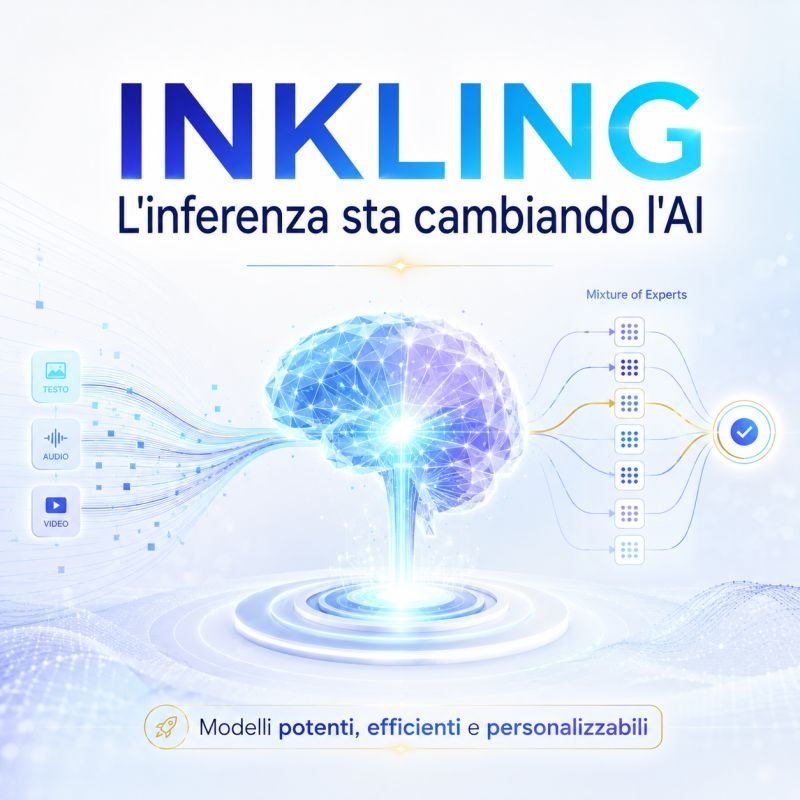
In summary
For years, the discussion focused primarily on training: more data, more parameters and more computing power. Today, however, competition is shifting towards what happens afterwards, when the model has to be used every day: speed, costs, resource consumption, response quality and the ability to adapt it to specific tasks.
Scenario and context
For years, the discussion focused primarily on training: more data, more parameters and more computing power.
Today, however, competition is shifting towards what happens afterwards, when the model has to be used every day: speed, costs, resource consumption, response quality and the ability to adapt it to specific tasks.
Into this context comes Inkling, the first open-weight model from Thinking Machines Lab, the company founded by Mira Murati.
Inkling is a multimodal model based on a Mixture of Experts architecture, with 975 billion parameters in total but approximately 41 billion activated during processing. It accepts text, images and audio, supports a context of up to one million tokens, and has also been designed for coding, tool use, RAG systems and agentic applications.
Its size is not the only interesting aspect.
Operational implications
The architecture activates part of the model for each request and allows the “reasoning effort” to be adjusted, seeking a balance between quality, response time and computational cost.
This is where inference becomes a practical issue.
A model is not useful merely because it performs well in benchmarks. It must be able to run sustainably, integrate into business processes and be customised around a particular organisation’s data and activities.
Inkling can be adapted through Tinker, Thinking Machines’ fine-tuning platform. This makes it a potential foundation for building AI agents, specialist assistants, multimodal systems and specialised applications.
It should be made clear, however, that “open-weight” does not automatically mean easy to run locally. A model of this size requires substantial hardware infrastructure and is not, at least today, a solution aimed at an ordinary SME workstation.
What changes for the company
The market signal is nevertheless clear: the challenge is no longer simply who builds the largest model.
It is who can make it work better, at sustainable costs, with greater control and within real processes.
The question for companies will therefore no longer be just:
“Which is the most powerful model?”
But above all:
Method and next steps
“Which model is best suited to my use case, how much does it cost to use, and how can I adapt it to my data?”
AI insights, training and business applications:
ai-academyitalia.it
Would you like to apply AI to your company?
Let’s start with a concrete, measurable and useful use case.
We can analyse processes, documents and repetitive activities to design an AI solution that fits the way you actually work.