
In summary
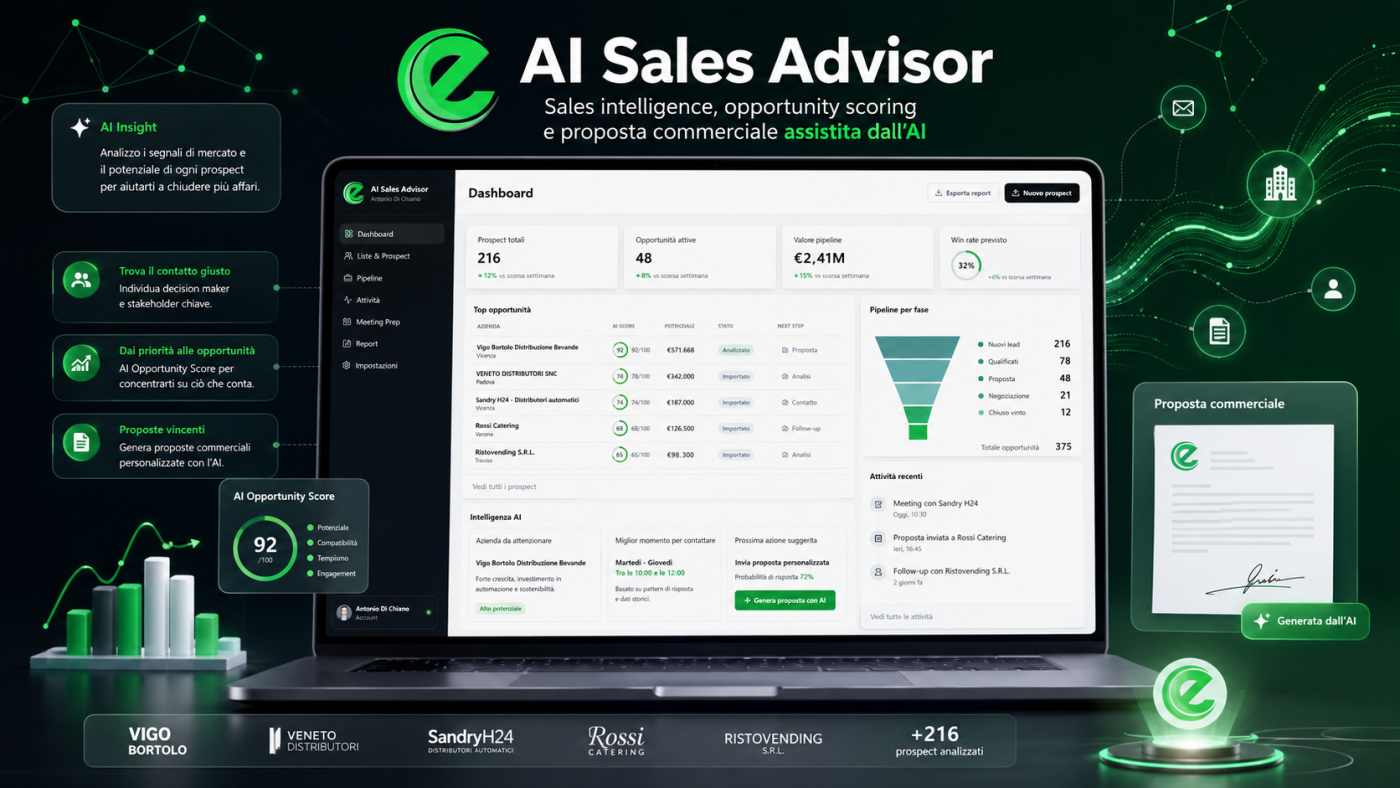
AI Sales Advisor: from a prospect list to a real sales strategy. Having hundreds of companies in an Excel file does not mean having hundreds of sales opportunities. The real work starts afterwards: identifying which companies are worth exploring, gathering reliable information, establishing their size and spending capacity, finding the right contact, understanding potential needs and deciding which proposal…
Scenario and context
AI Sales Advisor: from a prospect list to a real sales strategy
Having hundreds of companies in an Excel file does not mean having hundreds of sales opportunities.
The real work starts afterwards: identifying which companies are worth exploring, gathering reliable information, establishing their size and spending capacity, finding the right contact, understanding potential needs and deciding which proposal to present.
AI Sales Advisor was created to automate and organise precisely this stage.
It is an AI agent dedicated to Sales Intelligence that turns a prospect database into an enriched, analysed and prioritised sales resource, then supports the salesperson in preparing the initial contact, proposal and follow-up.
The current version has been configured specifically for my business model and for selling services related to artificial intelligence: assessments, training, governance, AI agents, RAG, private and on-premise solutions, and strategic support.
But this is a configuration, not a limitation of the product.
The same platform can be customised for any sales sector by changing the service catalogue, qualification criteria, scoring, information to research, pipeline and AI logic used to suggest the most suitable approach.
A company selling software, industrial services, consultancy, equipment, financial services or medical solutions could therefore use the same engine, fully adapting it to its own sales process.
Start with the prospects you already have
AI Sales Advisor does not require you to change the way you acquire contacts.
Prospects can be:
- imported from Excel or CSV;
- entered manually;
- organised into multiple lists;
- assigned to different lists at the same time;
- updated through subsequent imports;
- edited manually at any time.
For example, you can create lists such as:
Veneto manufacturing, Customers to contact again, Professional practices, Event leads, September prospects, High-priority companies.
The database remains a single resource, avoiding unnecessary duplication.
The agent looks for the information the salesperson actually needs
Basic company details are often not enough.
During its analysis, AI Sales Advisor can search online and consult different sources to try to complete information such as:
- registered company name;
- headquarters;
- address;
- city and province;
- VAT number;
- turnover;
- number of employees;
- website;
- telephone number;
- email messages;
- LinkedIn;
- business description;
- owner, director or decision-maker;
- role of the person identified.
The research can explore several online results when an important piece of information is not found immediately.
This is particularly useful for information such as turnover and employee numbers, which affect a company’s actual ability to support an investment.
But there is one piece of information I consider even more important from a sales perspective: the person to contact.
Knowing which company it is is not enough: you need to know who to speak to
A list of 500 companies and 500 info@company.it addresses is far less useful than a list that tells us who can make a decision.
That is why AI Sales Advisor pays particular attention to the relevant sales contact and decision-maker.
The prospect record can store the following separately:
- contact person or intended recipient;
- contact person’s role;
- direct email address;
- direct telephone number;
- owner/proprietor/decision-maker;
- decision-maker’s role.
Operational implications
This information can be retrieved through the analysis or entered manually when it emerges from a phone call, LinkedIn, research or a previous interaction.
This is an important distinction because it completely changes the quality of the next step.
Knowing that a company could be interesting is useful.
Knowing that the contact is Mario Rossi, Operations Director, allows you to prepare a message tailored to his role and the issues he is likely to manage.
The AI does more than collect data
After enrichment, the company’s context is analysed.
The agent tries to understand:
- business model;
- company structure;
- operational activities;
- potentially repetitive processes;
- document intensity;
- customer and sales management;
- level of digitalisation;
- existing digital systems or tools;
- critical issues;
- potential areas for improvement;
- signals that can help shape a proposal.
In the configuration I use personally, the analysis focuses on opportunities related to artificial intelligence.
The agent therefore tries to establish whether the company might be better suited to an assessment, a training programme, an automation project, a RAG system, an AI agent, a private solution or a longer-term engagement.
In another configuration, the same mechanism could look for completely different signals.
A score to decide where to invest your time
When you manage hundreds of prospects, prioritisation becomes essential.
AI Sales Advisor therefore assigns a Sales Priority score from 0 to 100.
The score does not simply measure whether a company “looks interesting”.
It takes several factors into account, such as:
- financial capacity;
- number of employees;
- organisational structure;
- operational opportunity;
- digital maturity;
- fit with the services being sold;
- ability to reach a relevant contact or decision-maker.
The result is organised into four categories:
A – High priority
B – Interesting prospect
C – Selective opportunity
D – Low priority
This allows you to open a list of hundreds of companies and immediately start with those that appear to offer the best balance of potential, size and sales prospects.
One important point is that missing information does not mean a value of zero.
If turnover cannot be found, for example, the system can indicate a provisional score and also show the reliability level of the analysis.
From the prospect to the service to propose
In the configuration dedicated to my AI services, the system compares the company’s profile with a specific sales catalogue.
It currently includes:
- strategic assessment and MappAI Valore;
- business AI training;
- AI Governance and AI Act Readiness;
- AI agents and automation;
- RAG and knowledge bases;
- Private AI and on-premise solutions;
- AI Architect in Residence.
The agent can therefore produce an evaluation such as:
- Primary recommended service: MappAI Valore
- Second opportunity: AI training
- Possible next step: Document AI agent
What changes for the company
In a different company, the catalogue could instead contain software, equipment, technical services, insurance, consultancy, industrial products or any other offering. This is one of the central features of AI Sales Advisor: its sales logic can be configured around the business that will use the application.
The pipeline is more than a list of statuses
After the analysis, the prospect enters a sales pipeline.
For example, it can move through stages such as:
To assess → Analysed → Opportunity identified → Approach defined → To contact → Contacted → Call booked → Proposal → Follow-up → Closed
But the pipeline does more than remind you “where things stand”.
AI Sales Advisor carries forward all the work done on the company.
When I reach the contact stage, I can already have the following available:
- contact person;
- role;
- email messages;
- telephone number;
- company analysis;
- sales priority;
- potential needs;
- suggested service;
- opening topic for the conversation;
- initial proposal;
- personalised email;
- a LinkedIn message;
- a follow-up;
- questions to ask on the call.
This greatly reduces the manual work normally required after choosing a prospect.
The salesperson does not have to start again with Google, reopen the website and rebuild the entire context each time.
Emails and proposals already prepared around the actual context
Once the relevant contact and opportunity have been identified, the AI can prepare a message suited to the prospect.
This is therefore more than generating a generic message such as:
“Good morning, I would like to introduce our services…”
The agent already has information about the company, the person’s role, the identified opportunity and the service that could make the most sense.
It can therefore prepare:
- an initial email;
- a follow-up;
- a LinkedIn message;
- a short message;
- a proposal introduction;
- points to use during a telephone call.
The salesperson naturally retains final control over the content.
The aim is to reach the contact stage with a prepared starting point, not to automate the indiscriminate sending of thousands of messages.
Preparing for the call
If the prospect responds, AI Sales Advisor can also become a sales preparation tool.
The Meeting Prep feature can summarise:
- what we know about the company;
- the issues we have hypothesised;
- information that still needs to be verified;
- the services that appear most appropriate;
- questions to ask;
- objections that might arise.
Information obtained during the conversation can then be entered manually in the record and become part of the prospect’s history.
Method and next steps
OpenAI, Gemini or another provider
The platform has been designed to use different AI providers.
The current version supports:
OpenAI
Google Gemini
The user can configure their own API and select the model to use.
This allows technologies and costs to be chosen according to the project’s requirements.
A local version with control over the data
AI Sales Advisor can be used as a local application.
The prospect database, lists, pipeline, notes, analyses and activities remain stored on the computer.
The workspace can be exported to create backups or transfer the work.
The interface is accessed through the browser, but the system runs locally.
This allows greater control over sales data than a platform fully centralised in the cloud.
It is neither a traditional CRM nor a simple email generator
AI Sales Advisor focuses primarily on the work that precedes and supports sales activity.
A CRM normally records what we know about a customer and what we have done.
AI Sales Advisor first aims to help establish:
who is worth contacting, what we know about them, who we should speak to, what problem they might have and which proposal would make the most sense to present.
Only then does the pipeline come into play.
The process therefore becomes:
Prospect → Enrichment → Analysis → Priority → Contact person → Service Match → Communication → Proposal → Pipeline
An engine that can be customised for different sales models
The version I use today was built specifically for selling the AI services offered by my business.
Its catalogue, scoring criteria, analyses and sales suggestions are therefore oriented towards that market.
But the structure of AI Sales Advisor is designed to be reconfigured.
For another company, the following can be changed:
- services and products;
- ideal customer;
- financial thresholds;
- minimum size;
- scoring parameters;
- information to research;
- priority criteria;
- questions to ask;
- pipeline;
- proposal templates;
- email messages;
- follow-up methods.
This allows AI Sales Advisor to develop from a generic application into a sales agent specialised in the particular business of the company using it.
AI Sales Advisor
It does more than find additional prospects. It helps us understand the ones we already have.
It enriches data, identifies contacts, analyses companies, assigns priorities, suggests the most suitable service and prepares the material needed to start a sales conversation.
The end result is simple: less time spent searching for information and more time devoted to prospects with a real chance of becoming customers.
Would you like to apply AI to your company?
Let’s start with a concrete, measurable and useful use case.
We can analyse processes, documents and repetitive activities to design an AI solution that fits the way you actually work.