


In short
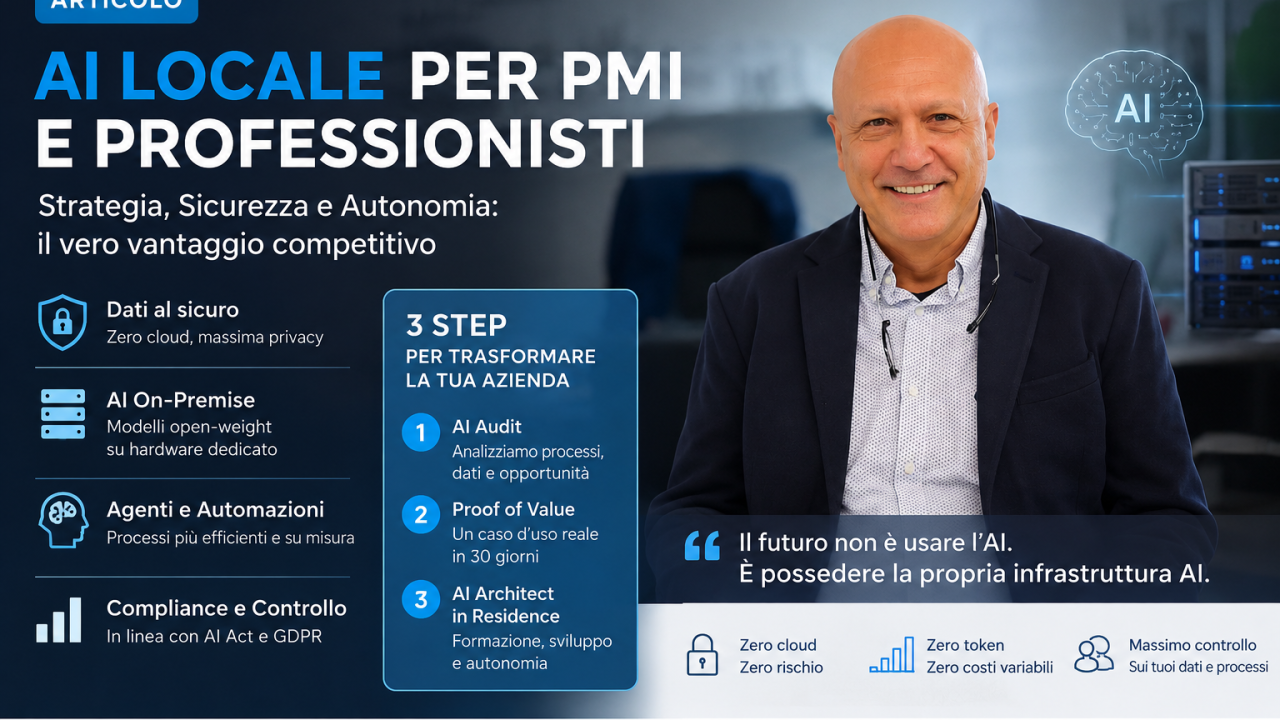
Local AI is not just a technical choice. For SMEs and professional firms, it can reduce dependency on cloud platforms, protect sensitive data and turn AI into a controlled internal capability.
Why local AI matters now
For many SMEs and professional firms, the question is no longer whether artificial intelligence can be useful. The real question is how to use it without losing control over data, processes and costs.
Cloud platforms are powerful and often convenient, but they are not always the right answer. When a company works with contracts, administrative documents, client data, technical reports, legal files or internal procedures, the perimeter of control becomes a business issue, not just an IT issue.
Local AI makes it possible to run models and agents inside the company’s own environment, on dedicated workstations or private infrastructure, reducing unnecessary exposure of sensitive information.
From experimentation to operational value
The first wave of AI adoption has often been based on experiments: prompts, generic chatbots, isolated subscriptions and disconnected tools. These experiments can be useful, but they rarely change the way the organisation works.
The real value appears when AI is connected to actual workflows: document analysis, reporting, sales support, administrative control, customer care, training and knowledge management.
In this context, local AI can become a stable operational layer. It does not replace people. It supports them by reducing repetitive work and helping them read information faster.
Privacy, compliance and human control
A local AI system can be designed to keep documents, datasets and outputs within the company perimeter. This is especially important for professionals and businesses operating with confidential or regulated information.
The point is not to reject the cloud. The point is to decide what should remain inside, what can go outside, and under which rules.
A serious AI strategy should define roles, permissions, logs, review processes and human supervision. Local infrastructure makes this governance easier to control.
What can be built first
A good starting point is a narrow but valuable use case: reading invoices, analysing contracts, searching internal documents, preparing management reports, creating a private knowledge base or supporting a sales team with updated information.
The objective is not to build everything at once. It is to prove value with a controlled project, measure results and then extend the system step by step.
For SMEs, this approach is more realistic than adopting a large AI platform without a clear operational plan.
The strategic conclusion
AI should become an internal competence, not only an external subscription. Companies that learn how to govern their own AI infrastructure will be better positioned on privacy, resilience and efficiency.
The future is not simply using AI. For many organisations, the future will be owning and governing the part of AI that is most critical to their business.
Want to apply AI to your company?
Let’s start from a concrete, measurable and useful use case.
We can analyse processes, documents and repetitive activities to design an AI solution that fits your real operational work.