
In summary
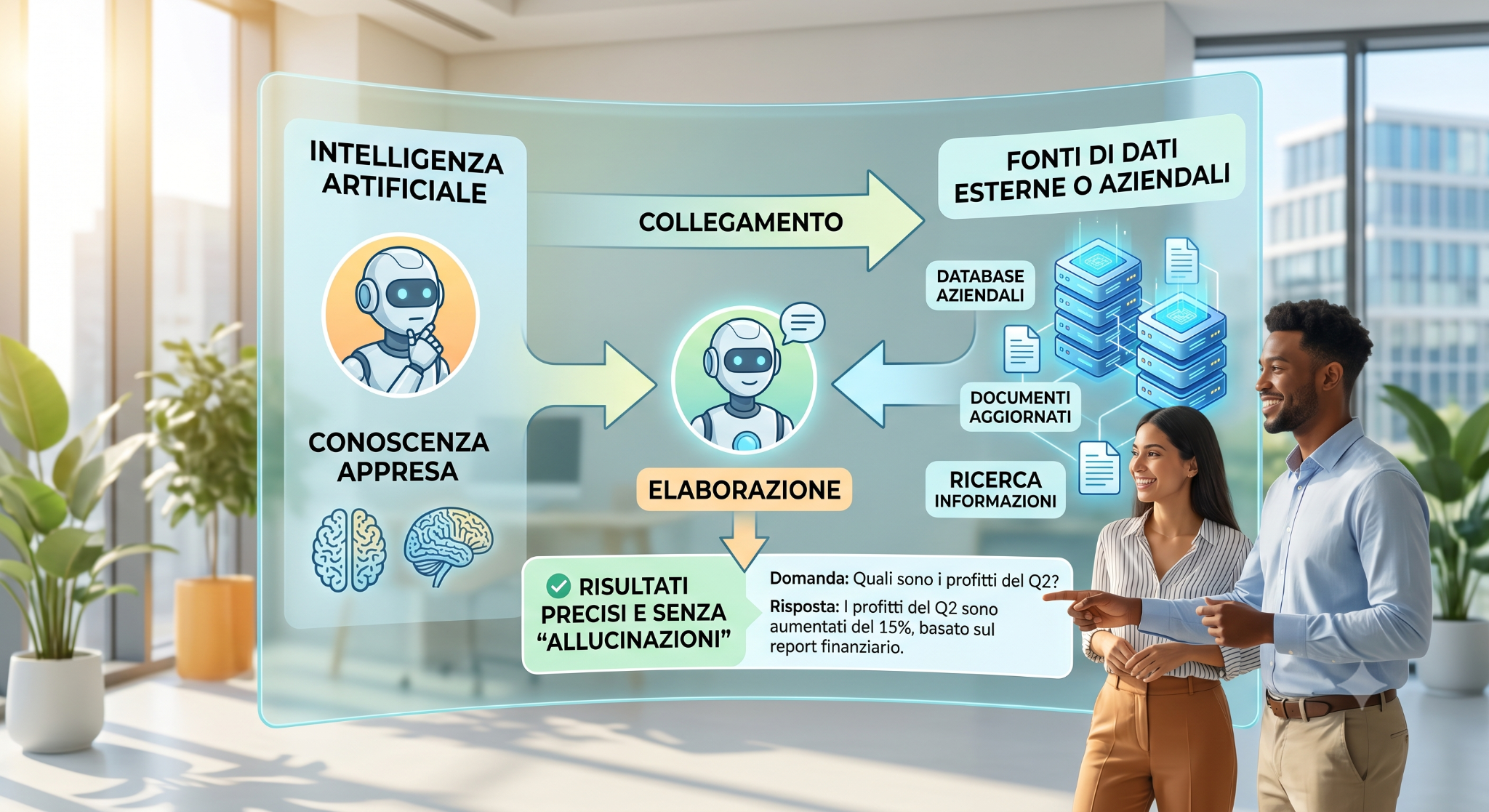
A well-designed RAG system connects AI to company documents, databases and knowledge bases, reducing hallucinations and allowing teams to query updated information without retraining the model.
What RAG really is
RAG stands for Retrieval-Augmented Generation. In practice, it is a technique that strengthens a language model by connecting it to external or company data sources. Rather than relying only on the model’s statistical memory, the system retrieves relevant information from documents or databases and uses it to construct the answer.
The difference is substantial: the AI no longer tries to “guess” from general knowledge, but reasons from specific sources. In a business context, this means being able to query procedures, manuals, contracts, FAQs, reports, price lists, technical specifications and internal archives with a much higher level of precision.
How it works in three steps
1. Information retrieval
When someone asks a question, the system searches the connected documents or data. It does not only look for identical words; it can also use semantic approaches to find conceptually related content.
2. Selection of the most relevant sources
From all the available content, RAG extracts the passages most useful for answering the question. This creates a controlled context and reduces noise.
3. Answer generation
The language model uses that context to generate a clearer, better-grounded answer and, when the system is well designed, one accompanied by the sources or document references used.
Why it is so useful in business
The first advantage is a reduction in hallucinations. A generic chatbot can give a fluent but incorrect answer. A RAG system, by contrast, is grounded in real documents.
The second advantage is the ability to work with current and private data. If you update a manual, procedure or archive, the system can use that content immediately, without retraining the entire model.
The third advantage is transparency. In many scenarios, the source or document passage used to produce the answer can be shown, increasing trust, verifiability and human control.
Where to apply it in practice
A well-designed RAG system does more than let you “chat with PDFs”. It can become a company knowledge engine supporting several departments.
- Sales: query price lists, quotations, catalogues, product information and FAQs.
- Administration: consult procedures, contracts, accounting documents and internal policies.
- Technical department: navigate manuals, specifications, equipment documentation and standards.
- Customer service: provide consistent answers based on up-to-date information.
- HR and legal: quickly find clauses, policies, internal documents and forms.
What is not enough to build a good RAG system
Uploading documents to a folder is not enough. Effective RAG requires structure. Content must be cleaned and organised, permissions defined, text-splitting methods chosen, metadata, versions and sources managed, and clear limits established on what the system may or may not use.
The level of supervision must also be decided. An informative answer may be sufficient for some activities. In others, particularly when operational or legal decisions are involved, it is essential that the final step remains human.
Local or cloud RAG: the choice depends on data, privacy and governance
RAG can be designed in the cloud, locally or using a hybrid architecture. If the data is public or not particularly sensitive, the cloud can provide a quick solution. If the documents contain know-how, contracts, customer data or confidential information, a local or on-premise component becomes particularly interesting.
The important point is not to follow a trend, but to design a system suited to the type of data being processed, security requirements, costs and the level of control the company needs.
How to get off to a good start
The best way to start is to select a precise use case: a procedures archive, a set of manuals, a knowledge base for internal support, a sales repository or a collection of technical documents. From there, you can measure answer quality, search time saved and the actual value generated.
Good RAG is more than technology. It is a project for organising knowledge. When it works well, it makes AI more reliable, more useful and much closer to everyday work.
Would you like to understand how to apply this in your company or practice?
Let’s start from a concrete, measurable and useful use case.
We can analyse processes, documents and repetitive activities to design an AI solution that fits your real operational work.