

Operational summary
For years, serious online publishing almost automatically meant WordPress, themes, plugins, caching, security and maintenance. AI now makes another route possible: small, custom publishing applications that follow the editor’s rules and update pages, metadata and sitemaps after human approval.
Scenario and context
I say this provocatively, but not entirely.
For years, publishing seriously online almost always meant the same stack: WordPress, a theme, plugins, SEO, caching, security, sitemaps, updates and maintenance.
Something has now changed.
With artificial intelligence, we are no longer limited to generating text or images. We can build real tools.
I did it for the blog on my own website.
Operational implications
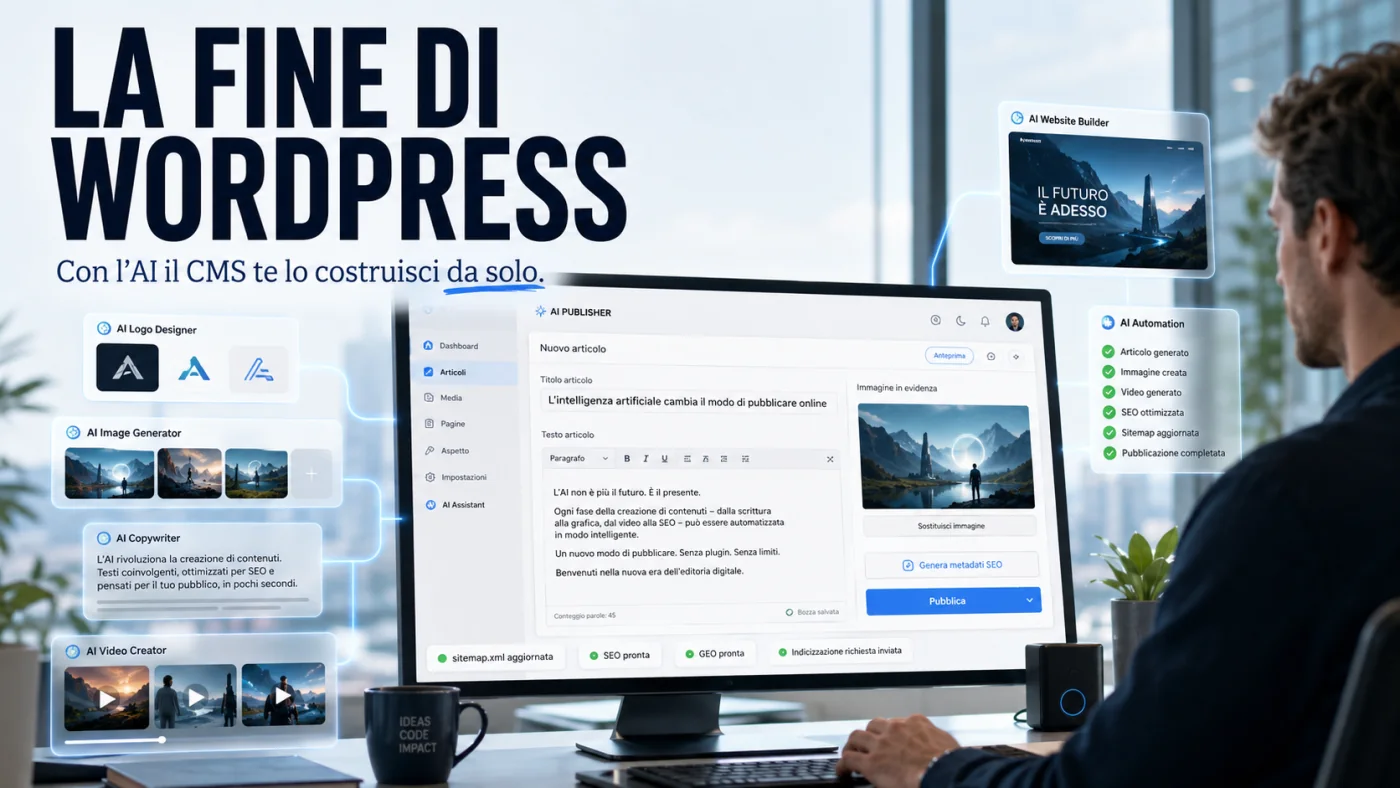
I created a small custom AI Publisher to update and manage the blog. First I prepare the title, article and image with ChatGPT. I then open the publisher interface, enter the ChatGPT API and press a button: the AI generates metadata, optimises the SEO layer, prepares the GEO structure and completes the technical work.
The application does not publish autonomously.
It waits for my approval.
When I click “Publish”, the new article appears on the blog hub, a dedicated page is created, sitemap.xml is updated, SEO data are configured and the content is ready for indexing.
Total time: approximately five minutes.
What changes for the company
This, in my view, is the real break with the past.
It is not simply “using AI”. It is designing a system that works according to your rules.
WordPress will not disappear tomorrow. It remains a large and useful platform. But its mental monopoly is ending.
Until recently, we assumed that online publishing necessarily required a general-purpose CMS filled with plugins and dependencies. Today we can build smaller, lighter and faster tools that fit the way we actually work.
The point is not to eliminate developers.
Method and next steps
The point is that people with clear ideas who know how to direct AI can turn a need into a real application: website, logo, graphics, images, text, video, SEO, GEO and an editorial workflow.
This is the new form of digital publishing.
Fewer standard platforms. More tools built around the real process.
Perhaps this is not the end of WordPress.
But it is certainly the end of the idea that WordPress must always be the mandatory answer.
Want to apply AI to your company?
Let us start from a concrete, measurable and useful use case.
We can analyse processes, documents and repetitive activities to design an AI solution that fits your real operational work.